
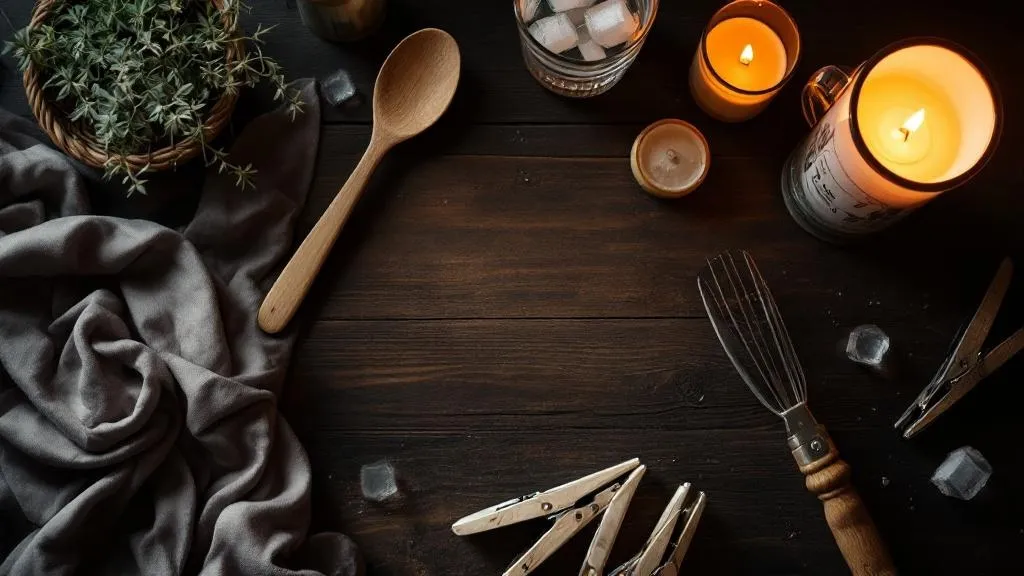
The Fantasy Factory wants you to believe you need a dungeon.
Black walls. A Saint Andrew’s Cross. A toy bag that costs more than your first car. It wants you scrolling through leather catalogs and specialty shops, quietly convinced that real kink doesn’t start until the equipment arrives — and that you, in the meantime, are just a beginner standing outside the gate.
That story serves the people selling you things. It doesn’t serve you.
Here’s what’s actually true: the most effective tool in any scene is your presence, your judgment, and your creativity. Everything else — every flogger, every piece of bondage rope, every sensation toy with a three-digit price tag — is secondary to the person holding it. And before you spend a single dollar, you have everything you need to start learning.
Your kitchen knows this. Your bathroom knows this. Even your junk drawer knows this.
The kink community has a word for everyday objects repurposed for play: pervertables. A wooden spoon is a pervertable. A silk scarf is a pervertable. A bag of ice cubes is a pervertable. The concept isn’t new — people have been making do with what’s on hand since long before there were specialty shops to make them feel inadequate about it.
This is a practical guide. Fifty items. What they do, how to use them, and what to watch out for. No shopping required.
Before We Start: Rules That Apply to Everything
I’m going to give you a list. But a list without context is a collection of accidents waiting to happen, so let’s establish ground rules that apply across every category.
Negotiate first. Every item you introduce — however innocent it looks — needs prior conversation. “I’d like to incorporate sensation play” is a sentence you say before the scene, not during it.
Consent is not a checkbox. It’s an ongoing conversation. Check in during play. Learn the difference between this is intense and I’m loving it and this is actually not okay. If you don’t know the difference yet, slow down.
Hygiene matters. Items that touch genitals or go near mucous membranes need to be non-porous, single-use, or thoroughly cleaned between uses. Wooden items are porous — keep that in mind.
Start lighter than you think you need to. Whatever sensation you’re imagining — cut it in half. Then cut it in half again. You can always increase. You cannot undo.
Aftercare is not optional. No matter how casual the scene, the person who surrendered to you is in a vulnerable state afterward. Be present. Be warm. Be there.
Now — let’s raid the house.
The Kitchen: Surprisingly Good Scenes Have Been Made Here
The kitchen is the Costco of pervertables. Dense, practical, full of things with unexpected applications.
1. Wooden Spoon
The original. Every kitchen has one. The narrow surface area concentrates impact and delivers a sharp, stingy sensation with every strike — this is a precision instrument, not a sledgehammer.
Safety note: Start lighter than you think you need to. Wooden spoons sting considerably more than they look like they should. Stick to fleshy areas — buttocks, upper thighs. Avoid the lower back, tailbone, and anywhere near the kidneys.
2. Silicone Spatula
Thuddy, flexible, quieter than wood. The flat face of a silicone spatula distributes impact differently — more of a slap than a crack. Good for people who want impact play but find the sharpness of wooden items too intense. Easy to clean.
Safety note: The flexibility makes it unpredictable at higher force. Start slow.
3. Rubber Spatula
Stiffer than silicone. Some rubber spatulas have just enough flex to create a satisfying snap without the severity of rigid wood. Experiment with the flat face versus the edge for different sensation profiles.
4. Rolling Pin
Heavy, solid, and useful for two different things: impact (with significant force, used carefully) and sensation rolling — dragging the cylinder slowly across skin for deep pressure play. The rolling application is the more interesting one. The weight of a full rolling pin moving deliberately across the back or thighs creates a dense, grounding pressure that some people find intensely satisfying.
Safety note: If using for impact, the weight means far less force than you think is needed. This is not a first experiment.
5. Chopsticks
Held together, a pair of chopsticks creates a pinching implement. Held apart, they deliver a narrow, precise sting when used for light tapping. The precision is the point — you can target very specific areas and create localized sensation.
Safety note: The edges of chopsticks can be surprisingly sharp. Light contact. Check the skin.
6. Ice Cubes
Temperature play is one of the most accessible forms of sensation play, and an ice cube is its simplest form. Drag it across the back, the chest, the inner thighs. Hold it still until the cold becomes almost unbearable. Contrast it with warm breath immediately after. The temperature differential is what creates the experience — that contrast is more dramatic than either element alone.
Safety note: Never hold ice against skin for extended periods. Keep it moving. Avoid numbing skin before impact play.
7. Plastic Wrap (Cling Film)
Used in safety-conscious ways, cling wrap is a simple mummification tool. Wrapping limbs — not the torso, not the neck, never the face — creates a sensation of containment and immobility that many submissives find deeply settling. Cheap, disposable, and you can cut it off immediately with scissors if needed.
Safety note: Always have scissors within arm’s reach. Never wrap the chest, abdomen, or neck. Monitor breathing. This is a restraint — all restraint protocols apply.
8. Honey or Chocolate Syrup
Sensory play doesn’t only mean pain and pressure. Temperature, texture, and taste are all sensation categories. Drizzling honey or warm (not hot) chocolate syrup across skin — particularly while the person is blindfolded — creates a sensory experience that’s both anticipation-driven and deeply physical. The cleanup negotiation is also a scene in itself.
Safety note: Sugar on or near genitals can cause infections. Keep food-based play away from mucous membranes. Check for food allergies.
9. Clothespins
The spring-loaded pervertable. Standard wooden or plastic clothespins apply moderate, sustained pressure. Removing them is often more intense than applying them — the blood rushing back creates a sharp sting. They work on nipples, labia, inner thighs, the fleshy skin along the sides of the torso.
Safety note: Limit application time. Fifteen to twenty minutes is a reasonable ceiling. Watch the skin color under the pin — if it goes very dark or the person reports numbness, remove immediately.
10. Cheese Grater (Handle Only)
This one is purely sensation, not impact. The handle of a box grater — the smooth metal or plastic grip — dragged across skin gives a mild scratching sensation. The temperature of metal adds another dimension. The grating surface is not for skin. Handle only. This cannot be overstated.
The Bathroom: Closer Than You Think
11. Shower Head
A detachable shower head with variable pressure settings directed at the genitals is a straightforward stimulation tool. Temperature contrast between warm and cool water adds another layer.
Safety note: Never direct high-pressure water into any body opening. The risk of internal injury is real. External stimulation only.
12. Loofah
The texture of a loofah dragged across sensitized skin creates mild abrasion. It’s a softer entry point into sensation play — the scratch-drag of rough texture across the back, thighs, or chest can be grounding, activating, or mildly arousing depending on the person.
Safety note: Loofahs harbor bacteria if not dried properly. Use a clean one. Avoid broken or irritated skin.
13. Natural Bristle Bath Brush
Used lightly, a natural bristle bath brush creates a scratching sensation without breaking skin. The broad flat back of the same brush can be used for light impact. Two implements in one.
Safety note: Inspect bristles. Hard, sharp, or uneven bristles can cut. Test on the back of your own hand first.
14. Electric Toothbrush
One of the most underrated sensation tools in the house. The vibration of an electric toothbrush applied to nipples, the perineum, the inner thighs, or the clitoris delivers targeted stimulation with variable intensity. It’s not a replacement for a vibrator — it’s a completely different sensation profile — but as a teasing tool, it’s remarkably effective.
Safety note: Clean before and after. The toothbrush is going back in someone’s mouth eventually.
15. Cold Water from the Tap
Run cold water over your hands. Apply them to warm skin. The contrast is immediate and sharp. As a dominance tool — pulling someone under cold water in the shower, deliberately and without warning — this is intensely activating for the right person and extremely unwelcome for the wrong one. Negotiate temperature play as its own conversation.
16. Hot Water Bottle
On the warmth end of temperature play, a hot water bottle pressed against the lower back, abdomen, or inner thighs during restraint creates deeply grounding warmth. Useful for aftercare as much as for the scene itself.
Safety note: Water temperature should be warm, not scalding. Test on your own inner wrist first. Cover with a cloth layer if there’s any doubt.
17. Hairbrush (Paddle Back)
The flat wooden back of a traditional hairbrush is a classic impact implement — firm, rigid, targeted. The handle gives you control. The flat face covers a larger area than a wooden spoon. The bristle side inverts the function entirely: dragged lightly across sensitized skin, it delivers prickling sensation that falls somewhere between tickle and sting.
Safety note: The firmness means marks appear quickly. Check regularly. Aim for the same padded areas as all impact play.
18. Hair Tie
Snapped against the wrist or inner thigh, a single hair tie delivers a sharp, brief sting. Not a scene in itself, but as punctuation — a snap to get attention, to mark a moment, to create sharp contrast against gentler touch — it has a place.
19. Cotton Balls Soaked in Witch Hazel
Cold, lightly astringent, with a mild scent. Dragged across the face or chest of a blindfolded partner, they deliver a sensation that’s cooler than room temperature and surprising in its softness. Good contrast against rougher textures.
20. Disposable Razor Cap
The small plastic cap from a disposable razor has a slightly ridged surface. Dragged very lightly across skin, it creates a scratching sensation similar to a wartenberg wheel — not breaking skin, but creating a line of sensation. Pressure is everything here. Use the cap. Never the blade.
The Bedroom: Already Set Up for This
21. Scarves
Silk, satin, or any smooth fabric scarf is a blindfold, a wrist restraint, or a gag. For a soft blindfold, fold into a thick band and tie firmly but comfortably behind the head. For light wrist restraint with consenting, cooperative partners, they work for gentle bondage. They are not secure restraint. They are aesthetic and sensory.
Safety note: Fabric knots tighten under pressure. Check circulation frequently. Have a way to cut the material if needed. Never tie scarves around the neck.
22. Neckties
Same principle as scarves, different texture and association. A silk tie across the eyes is cleaner and cooler-feeling. A firm tie around bound wrists carries a specific formality — there’s something about being bound with a necktie that carries psychological weight beyond the physical restraint.
Safety note: Same as scarves. Fabric knots compress under tension. Check circulation. Have scissors.
23. Belts
A leather belt folded in half and used as a strap delivers a thuddy, broad impact. Held by the buckle end (with the buckle safely in your grip) and swung by the folded end, it’s a solid impact implement. Drawn through its loops and used to secure wrists to a headboard, it’s a classic restraint.
Safety note: Buckle stays in your grip at all times. The metal will cut. As restraint, circulation rules apply — check frequently.
24. Extra Pillows
Not a sensation tool — a positioning tool, which matters just as much. Pillows folded under the hips raise the pelvis for rear-entry penetration, improve access during oral play, or create a specific angle for impact play. Good dominant technique includes controlling how your partner’s body is positioned. Pillows are infrastructure.
25. Bed Sheet Tied Around a Bedpost
With a cooperative partner and a clear conversation, a bed sheet tied to a headboard creates an anchor point for a wrist. Softer than rope, more improvised in feel — but the psychological effect of being anchored to the bed is comparable to purpose-built restraints. Always ensure the knot is accessible and the sheet can be removed quickly.
Safety note: Bedposts and headboards vary in structural strength. If the anchor point feels unstable, it is. Don’t use it.
26. Sleep Mask (Eye Mask)
Better than a scarf for blindfolding because it’s designed to stay in place. The darkness it creates is complete. Sensory deprivation dramatically amplifies every other sensation — a touch that would be mild becomes sharp, a sound becomes significant, and the anticipation of not knowing what’s coming becomes its own experience.
27. Soft Rope from a Camping Kit
If you have rope already — camping gear, moving supplies — you have something to work with. Soft cotton rope is more beginner-friendly than synthetic materials. Learn at least one reliable quick-release knot before using it. Keep medical shears somewhere accessible. Never leave a restrained partner unattended.
Learn more about rope fundamentals in the full bondage guide.
28. Wireless Earbuds (With Selected Audio)
Playing sound directly into someone’s ears during a scene creates a degree of sensory control that’s subtle but effective. You’re managing their auditory environment. They can’t hear commands, can’t anticipate sounds, and become significantly more attuned to touch. Your movement around the space becomes a form of control.
Safety note: Establish a non-verbal signal the partner can use while wearing earbuds — a repeated tap, a specific hand gesture — that communicates “I need to stop.” Test the signal before the scene.
29. Velvet or Crushed Velvet Fabric
A scrap of velvet fabric dragged slowly across the skin creates a specific, enveloping texture — neither rough nor smooth, but something in between that many people find intensely pleasurable. Contrast it with the handle of a wooden spoon, with ice, with the edge of a ruler. Sensation play is about contrast and sequence as much as individual stimulus.
30. Feather from a Pillow
One end of the sensation spectrum. A single feather drawn slowly across highly sensitized skin delivers the lightest possible sensation — particularly potent after other more intense sensations have heightened sensitivity. Contrast is everything: feather after slap, warmth after cold, silence after instruction.
Safety note: Confirm no feather allergies before use.
Office and Garage: The Junk Drawer Delivers
31. Ruler
The flat back of a wooden ruler is an impact implement with particular precision. The narrow face delivers a targeted sting. The school-era association adds psychological weight for some people. Worth keeping one around specifically for this.
Safety note: Wooden rulers can break at impact, creating splinters. Inspect before use. Aim for padded areas only.
32. Binder Clips (Metal, Small Size)
Stronger than clothespins. Significantly stronger. Metal binder clips apply serious, sustained pressure and should be treated as an intermediate implement, not a casual experiment. Start with the smallest available size.
Safety note: Time limits apply here more strictly than with clothespins. Five to ten minutes maximum. Never leave someone unattended with them applied. Remove immediately if the person reports numbness or skin goes very dark.
33. Paracord or Utility Rope
If you have paracord from any outdoor or utility purpose, it functions similarly to purpose-built bondage rope, though it can be rough on skin. The principles of safe bondage apply regardless of rope source: no pressure on nerves or blood vessels, never around the neck, check circulation every few minutes, always have a way to cut immediately.
34. Duct Tape — With a Significant Caution
Duct tape is widely used in kink and frequently misused. The adhesive on industrial duct tape is aggressive — removing it from skin can strip the surface layer and cause significant, unplanned pain. If you’re going to use tape for bondage, medical tape or kinesiology tape (KT tape) is a far safer choice. Duct tape, if used at all, should not go on sensitive areas, never on the face, and you should test the adhesion on a less sensitive area first.
35. Wooden Dowel
Available at hardware stores for roughly nothing. A wooden dowel can be used as a spreading bar between the hands, as a makeshift cane (with all the skill requirements that implies), or as a sensation tool for rolling pressure.
Safety note: Hardwood on skin at any meaningful force can break skin. Start lighter than you think necessary and inspect the dowel for splinters before use.
36. Rubber Bands (Single, Not Bundled)
A single rubber band snapped against the wrist or inner thigh delivers a sharp, brief sting. Very low intensity, very localized. Useful as punctuation in a scene — a consequence, a signal, a small jolt of attention. Not a serious impact tool; don’t bundle multiple bands or use thick ones.
37. Leather Work Gloves
Leather against skin feels different from skin against skin. The weight and texture create a different sensation when gripping, scratching, or striking. A slap with a leather-gloved hand is both sensory and auditory in a way bare hands aren’t.
38. Latex Gloves (Medical or Cleaning)
Different energy from leather — more clinical, colder. Some people respond very strongly to the latex aesthetic specifically. Beyond aesthetics, latex gloves are simply practical hygiene for manual stimulation. The sensation of latex against sensitive skin is its own category.
Safety note: Latex allergies exist and are serious. Confirm before use.
39. Cable Ties (Zip Ties) — With Extreme Caution
Zip ties cannot be easily loosened once fastened. They tighten under pressure and can cut circulation within minutes. If you use them at all — and this is genuinely not a beginner tool — you need EMT scissors within arm’s reach at all times. Check circulation every ninety seconds. Honestly? Buy actual restraints instead. The aesthetic isn’t worth the risk.
40. Kitchen Timer (Visible, Mechanical)
Setting a visible timer creates a defined scene structure. “This lasts fifteen minutes” gives both of you a clear endpoint, removes the anxiety of not knowing when it will end, and creates a natural rhythm for escalation and wind-down. The ticking of a mechanical timer is also, incidentally, a mild psychological tool — the sound of time passing, audible.
Ten More Worth Knowing
41. Gardening Kneeling Pad (Foam)
Scenes that involve extended kneeling are painful on hard floors without protection. A foam kneeling pad protects joints, extends the time someone can hold a position, and costs almost nothing. Kneel-heavy dynamics benefit enormously from this.
42. Yoga Mat
Scenes that happen on hard floors are uncomfortable in ways that interrupt the experience. A yoga mat is basic floor padding that makes prolonged floor work possible. It also defines the scene space physically — everything within the mat is the scene, everything outside it is not.
43. A Single Taper Candle
Wax play is one of the most visually striking forms of sensation play, and a plain white taper candle from any grocery store is where you start. The key variable is drop height: the higher you hold the candle, the more the wax cools before hitting skin, the milder the sensation. Lower height means hotter wax means more sensation means more risk. Start high. Learn the candle’s behavior.
Safety note: Use only unscented paraffin candles or plain soy candles. Beeswax, scented candles, and colored candles melt hotter and behave unpredictably on skin. Never drip wax on the face or near the eyes. Have water accessible. See also: sensory play guide.
44. Wooden Hairpin or Single Chopstick (Dragged, Not Struck)
A single thin wooden stick — chopstick, large hairpin — dragged lightly in slow lines across the skin creates a deliberate, trailing sensation. The precision of a single point moving across the back, over the shoulder blades, down the spine, is entirely different from broad-surface sensation. This is what a wartenberg wheel does at ten times the price.
45. Velcro Cable Ties
Available in any office supply or electronics store, sold for managing cords. They can be used as quick-connect wrist restraints — fast to apply, fast to release, adjustable. Not built for heavy struggle, but excellent for light restraint or as a low-commitment introduction to the feeling of being bound.
Safety note: Two fingers should fit snugly between the tie and the wrist. Check circulation before starting.
46. Metal Spoon (Temperature Tool)
Place a metal spoon in a glass of ice water for a few minutes, then draw the rounded back slowly across skin. Place another in warm water and use it against sensitive areas. Two spoons — one cold, one warm — used in alternation creates disorientation that is far more interesting than either alone.
Safety note: Test temperature on your own inner wrist before applying to a partner. Warm-to-the-hand can feel significantly hotter against more sensitive skin.
47. Mint Lip Balm or Peppermint Oil (Diluted)
Menthol creates a sustained cooling sensation that builds and intensifies with air exposure. Blowing on an area treated with menthol produces a significantly stronger effect — useful to know and to demonstrate deliberately. The sensation continues as long as the compound is on the skin.
Safety note: Test on a small area first. Never apply internally. Have a neutral carrier oil available to dilute if intensity becomes too much — water alone spreads it.
48. Dishcloth (Rolled Tight and Snapped)
A tightly rolled kitchen towel snapped like a rat tail delivers a sharp, quick sting. Lighter than most implements but precise. It requires a specific wrist snap technique to generate any force, which actually makes it a decent learning tool for developing your mechanics before using heavier implements.
49. Pillow (For Restraint Positioning)
In addition to general positioning use, a pillow pressed against the face creates a form of mild sensory deprivation and mild breathplay sensation when the person pushes into it. This is a nuanced use that requires constant attention — never press, never restrict breathing, and this is for experienced partners who have specifically negotiated this.
Safety note: Breathplay of any kind requires explicit negotiation and careful monitoring. Never press down; let the person control the contact themselves.
50. The Back of Your Bare Hand
Last on this list, and maybe the most important.
The back of your hand drawn slowly across the jaw, the throat, the sternum — deliberate, quiet, unhurried — communicates dominance more clearly than most of what’s on this list. Skin on skin. Presence. Control. No implement required.
The best sensation tool you own is your hands, your voice, your attention, and your intention. Everything else is supplemental.
Safety Notes by Category
Impact play: Always target fleshy areas (buttocks, upper thighs, sit spots). Avoid the lower back, spine, tailbone, kidneys, joints, and the back of the knees. Start lighter than you intend to. Marks appear more quickly with household items than you expect — check skin regularly.
Restraint: Check circulation every two to three minutes. Two fingers should fit between restraint and skin. Have a way to cut the restraint immediately — medical shears or scissors always within arm’s reach. Never restrain around the neck. Never leave a restrained partner unattended.
Temperature: Test everything on your own skin first. Keep cold items moving — never hold ice against skin for extended periods. Test warm items on your inner wrist before applying to a partner. Have a way to rapidly adjust temperature if needed.
Sensation play: Many items create delayed sensation — what feels mild at application becomes intense ten seconds later. Go slower than you think you need to, especially with chemical sensation tools like menthol. Always negotiate the full range of what you’re planning.
Hygiene: Items used in genital contact should be non-porous or single-use. Wooden items are porous and should not be shared. Designate pervertables that won’t go back to regular household use.
When to Upgrade to Purpose-Built Equipment
There’s a moment in most people’s development where household items feel limiting. That’s good — it means you know what you’re doing well enough to know what you actually need.
Signs it’s time to invest:
You’re using it often enough that specialization is warranted. If clothespins are a regular part of your scenes, actual nipple clamps with adjustable tension give you more precision and control.
You’ve hit the safety ceiling of the improvised version. Paracord scratches skin in ways proper bondage rope doesn’t. A wooden spoon can’t be as reliably calibrated as a purpose-built paddle. When the improvised version creates safety friction, purpose-built equipment removes it.
You want more range. A wooden spoon occupies one point on the impact spectrum. A full arsenal of impact toys gives you the whole range — from the thud of a heavy leather paddle to the bite of a thin cane. That range creates richer scenes.
Go gradually. Buy one good thing rather than five cheap things. Buy quality single-purpose tools from reputable makers and learn them well before adding more.
Equipment Doesn’t Make the Dominant
Here’s the thing the Fantasy Factory never wants you to understand: equipment doesn’t make you a dominant.
The Cosplayers figured this out in reverse — they assembled the full kit, the black aesthetic, the gear, and assumed the tools would do the work. They don’t. They never did. A dungeon full of implements in the hands of someone with no presence, no skill, no real connection with their partner is just a room full of objects.
A wooden spoon in the hands of someone who is fully present — who reads their partner, who calibrates each moment to what’s actually needed, who stays attuned from negotiation through aftercare — that’s a scene. That’s something real.
Underground Truth: the most important skills in this entire practice — negotiation, attunement, calibration, aftercare — don’t require a single purchase. They require practice, attention, and a partner who trusts you.
You’re not waiting for equipment. You’re not waiting to be ready. You’re not waiting for the shopping cart to empty.
Start now. Start with what you have. Learn your partner’s responses before you learn any implement. Understand what sensation does to them before you worry about what any particular tool looks like.
The equipment comes later. The Dominant is already there.
Ready to understand where you are in your development? Take the quick quiz — the real work isn’t in the gear.
When you’re ready to build a real toolkit: impact toys explained — restraints and bondage fundamentals — sensory play from ice to wax.