
 Sir Linus

The Problem
You’ve seen them at the Halloween superstore. The “sexy dominatrix” costume — black pleather bustier, PVC thigh-highs, a plastic crop with a heart-shaped tip. Twenty-nine dollars. Bought by someone who wants to feel powerful for one night, returned the morning after, or shoved to the back of the closet next to the vampire cape.
That’s the Fantasy Factory’s version of fetish wear.
They took something with real psychological weight — leather that smells like it was made to outlast you, latex that turns your body into a different kind of object, a harness that reorganizes how you inhabit your own chest — and they turned it into a costume. Cheap. Disposable. Theatrical.
And somewhere along the way, they convinced a lot of people that fetish wear is theatrical. That putting on leather means you’re performing. That wearing a harness is for people who need props because they don’t have the real thing underneath.
The real practitioners in the Underground cringe at this.
Not because they’re gatekeeping. Because they know what material actually does to a person — both the person wearing it and the person watching it get put on.
The Fantasy Factory sold you the Halloween costume and called it the identity.
They gave you PVC that doesn’t breathe and said: that’s what dominance looks like. They gave you a $15 set from a party site and said: that’s enough to feel the part. They strip-mined the aesthetics of real power exchange, packaged them in cheap plastic, and profit from the fact that most people don’t know what they’re missing.
But you’re starting to suspect something different. That the weight of real leather might actually change how you stand. That a harness across your chest might not be vanity — it might be the first act of a scene you haven’t formally started yet.
That suspicion is correct.
The Flip
Forget transformation for a moment.
The Fantasy Factory sells fetish wear as transformation — you put on the costume, and you become someone else. Something more powerful, more mysterious, more dominant than you actually are.
That’s backwards. And it’s exactly wrong.
Here’s what real fetish wear does: it reveals. It doesn’t create.
The dominance was already there. The authority was already in you. The capacity to hold space, to make a submissive feel genuinely claimed, to inhabit a scene rather than perform one — that doesn’t come from leather. It was never going to come from leather.
But leather? Real leather, chosen for what it is and not what the costume aisle says it should be? That leather doesn’t pretend. It doesn’t make you someone else. It removes one layer of civilian life and lets what’s already underneath become visible.
The weight of a good harness across your chest changes how you stand. Not because the harness has magical properties. Because your body has been given a physical anchor — something that makes your natural authority more legible to your nervous system and to the person across from you.
The restriction of latex on your submissive’s body doesn’t create their submission. But it marks a threshold. Their skin knows they’re not in ordinary space anymore. Their body is being shaped, covered, claimed by something you chose for them. That choosing is dominance. The material is just the language it speaks in.
Real fetish wear isn’t about looking the part. It’s about the transformation that happens when you put it on — not a transformation into something new, but a transformation back into what you already are. The civilian clothes come off. The armor goes on. And whatever has been caged by the workday, the email inbox, the relentlessly ordinary surface of regular life — it gets a little more room to breathe.
Equipment as revelation, not transformation.
That’s the flip. That’s what the Underground understands and the Fantasy Factory never will.
Materials
The material you choose is the first statement you make. Before a word is spoken, before a rule is established, the material on your skin — or theirs — is already communicating.
Leather
The classic. The oldest fetish material by centuries. And still, for most people who’ve worked with it, the most honest.
Leather is animal hide. That’s not metaphor — it’s literal. When you wear real leather, you’re wearing protection that once kept something alive. The ancestral weight of that registers in ways that are difficult to articulate but immediately felt. There’s a reason leather became the material of warriors, of people who rode horses through uncertain territory, of workers whose bodies depended on their equipment holding.
That history is in the smell. The smell of leather isn’t neutral — it’s one of the most consistently psychologically powerful sensory triggers associated with the aesthetic. Submissives report noticing it before anything else. It says: something real is happening here.
Leather has heft. It makes sound — the creak when you move, the specific weight of it across your chest. It has texture. It drapes differently depending on weight and tanning. Suede is soft and intimate. Patent leather is formal and precise. Latigo is stiff and structural.
What leather understands that cheaper materials don’t: it ages with you.
A leather harness worn regularly for three years looks different from a leather harness worn for three years and left folded in a drawer. The one that was used develops a patina — a particular softness in the places that receive the most contact, a deepening of color, a memory of the body that wore it. This is leather telling the story of where it’s been.
A Dominant who shows up in leather that has clearly been lived in is communicating something no new equipment ever could: this is not a phase. I’ve been doing this long enough that my gear remembers.
Quality leather is not cheap. A good leather harness from a real leather goods maker is a hundred dollars at minimum, often two or three times that for custom work. This is not an entry-level purchase — it’s an investment. Treat it like one.
Why quality leather is an investment, not an expense:
A $30 PVC harness will look like a $30 PVC harness in six months — stretched, cracked, the sheen worn off unevenly. A $150 quality leather harness, properly conditioned, will look better in six months than it did when you bought it. The economics are not what they appear at the point of purchase.
Latex
Latex is a different category from leather. Where leather is ancient and earned, latex is intimate and transformative. It communicates something fundamentally different.
Latex is a second skin — and this is meant almost literally. It maps to the body so precisely that the surface of the skin becomes a surface of the material. The individual texture of a person — the variations in skin tone, the organic irregularity of a human body — disappears beneath the high sheen. What remains is shape. Pure shape. Curves and planes rendered in a material that doesn’t allow the eye to rest on anything particular.
For submissives, this is the objectification material. There’s a reason latex full-body suits and hoods are associated with the most complete forms of transformation play. A submissive in full latex stops being a person in an outfit and starts being something else — a specifically shaped object in your care. Many submissives describe the state that follows as different from anything they can access in ordinary fabric.
For Dominants who want to dress their submissive in something that marks the body as territory — as claimed, as reorganized according to another’s will — there is nothing more efficient than latex.
The ritual of putting it on is part of its power.
Latex doesn’t slip on. It requires preparation: the inside of the garment must be dusted with unscented talc, then the material is worked onto the body inch by inch, smoothed into position, checked for air pockets. Then, once on, it can be polished with silicone shine spray — and the transformation becomes visible in real time. The wearer is watching themselves become something different in the mirror.
For Dominants who dress their submissive: the process of applying latex is intimate authority. Your hands are on their body throughout. The material they’ll inhabit for this scene is going on because you’re putting it there.
Latex is demanding in another way: it requires commitment and care. It tears if mistreated. It degrades with heat and petroleum products and metal contact. It needs to be stored correctly. This is material for people who are serious about what they’re doing, not people looking for something to wear twice and abandon.
PVC and Vinyl
PVC is the accessible alternative, and there’s no shame in that.
From a reasonable distance, good-quality PVC is visually indistinguishable from patent leather. The high-gloss finish reads similarly. The price point is significantly lower. And for exploration — for the person who wants to understand whether the leather aesthetic resonates before committing to the cost — PVC is a reasonable starting point.
The limitations are real. PVC doesn’t breathe. Extended wear creates heat and sweat accumulation in a way that leather, which has more porosity, manages better. PVC doesn’t age — it doesn’t develop patina or character. In six months it looks the same as the day you bought it, and in two years it looks worse. The material has no memory, no accumulation.
What PVC offers: the look. The visual language of leather authority at lower cost and with easier cleaning. For play-only pieces — garments worn for a scene and then wiped down — the non-porous surface is actually practical. Nothing soaks in.
Use it as an entry point. Use it for pieces that are primarily visual rather than tactile. When you know what you want and why, invest in leather.
Neoprene and Mesh
Modern materials have given fetish wear a third aesthetic: athletic, practical, contemporary.
Neoprene is wetsuit material — thick, flexible, structurally sound. It holds shape without the weight of leather. It’s machine washable. It doesn’t require conditioning. And it has its own aesthetic: not the gleam of leather or the sheen of latex, but something more utilitarian. There’s a sport-adjacent quality to neoprene harnesses and hoods — a functional-authority look that appeals to Dominants who want equipment that communicates “this works” rather than “this is beautiful.”
Mesh and technical fabrics occupy similar territory. Breathable, modern, less formal. A harness in technical mesh reads differently from one in black leather — neither is more or less dominant, but they speak in different registers.
Both are equally valid. Dominance doesn’t require a particular material. It requires that you choose deliberately — that whatever covers your body or your submissive’s body was selected with intention and with clarity about what that selection communicates.
Pieces
Every piece of fetish wear does something specific to the body that wears it. Understanding what each one does lets you choose with precision rather than aesthetics alone.
Harnesses
A harness is architecture imposed on a body.
Straps cross the chest, frame the torso, divide the body into geometry defined by someone’s deliberate decision. The harness doesn’t just sit on top of the body — it reorganizes it. It creates structure where there was organic form. Lines appear that weren’t there before. The body becomes a structure with a visual logic.
For the Dominant wearing a harness: the geometry changes your silhouette. Leather straps across the chest make the visual width of the shoulders more defined. You didn’t just dress. You armored. The harness projects structure — deliberate, intentional, prepared.
For the submissive wearing a harness: the straps make the body feel claimed. This is wearable ownership. Even when nothing else is happening — when you’re across the room, attending to something else — the harness reminds them that their body has been organized according to your will. It creates a containment feeling: a pleasant, constant pressure that functions as physical reminder of the dynamic without requiring your active attention.
Body harnesses range from minimal chest pieces to full-torso configurations — shoulder straps, chest bands, abdominal crossing, thigh connections. The more complete the harness, the more complete the sense of body-as-territory. A full chest harness that connects to thigh harness straps creates a sense of having been mapped.

Soft garment leather that sits against the chest like a second skin. Adjustable straps let you dial the fit until it feels less like wearing something and more like becoming something.
Affiliate link - price may vary. We may earn a commission at no extra cost to you.
Corsets
The corset does something no other garment in the fetish wear arsenal does: it enforces posture through structure.
The boning inside a corset — steel in quality pieces — forces the torso upright. The shoulders go back. The waist defines. The wearer physically cannot slouch, cannot collapse inward, cannot forget that something is shaping their body. And whoever laced that corset is the reason they cannot forget.
Worn by a submissive: the corset is the Dominant’s will made into an object around their waist. Every breath — particularly every deep breath, which the corset restricts — is a reminder that their body is being shaped. The restriction isn’t painful (in a properly sized and worn corset) but it is constant. Every movement carries the memory of constraint.
Worn by a Dominant: the corset operates as armor. The forced-upright posture reads as imposing. The contained silhouette reads as controlled. There is nothing casual or apologetic about the body language of someone in a properly fitted corset. It is a held authority, structured into clothing.
There are also power dynamics in the lacing — the act of standing behind your submissive, pulling the laces tight, watching them adjust to the restriction. This is intimate authority in action. You are compressing their body, systematically, with your hands. By the time the last knot is tied, the scene has already begun.
Steel-boned corsets are superior to plastic-boned for anything beyond aesthetics. They hold shape, achieve genuine waist reduction, and last significantly longer. Leather corsets project the most authority; fabric corsets offer the most comfort for extended wear.
Hoods and Masks
When you cover the face, you change who — or what — is in the room.
This is the most psychologically extreme transformation that fetish wear can accomplish. Leather gloves and harnesses reorganize the body. Corsets reshape posture. But a hood removes the feature that makes a person recognizable as themselves — the face. The eyes, the expressions, the individual identity communicated by a human face — gone, or altered.
A submissive in a full hood stops being a person with a face and becomes something else entirely. The precise something-else depends on the hood: latex hoods with sealed eyes become sensory-isolation objects. Leather hoods with open mouths create a specific kind of availability. Hoods with grommets and mesh eyes create a distorted, obscured gaze — the submissive can see out, but what’s looking out is no longer quite a face.
For Dominants who are drawn to identity transformation play, hoods and masks are the most direct tool available. You’re not restraining the body — you’re altering what the submissive is while they wear it. The gap between who walked into the room and what is now in front of you is the site where the Mindbender works.
Masks accomplish similar goals with less coverage. A mask over the eyes creates partial anonymity — the submissive becomes both familiar and obscured. A lower-face mask leaves the eyes visible but covers the mouth and jaw — the expression becomes unreadable, which creates its own particular dynamic.
For Dominants: masks can also be worn as an identity tool. Your face, too, can be removed — made anonymous, made less readable. Becoming less person and more presence.

Complete blackout. Total identity erasure. When the hood goes on, the person underneath disappears — and what remains is pure, distilled submission. Not for the faint-hearted or the unclear of intention.
Affiliate link - price may vary. We may earn a commission at no extra cost to you.
Gloves
Gloves are the most underestimated piece of fetish wear.
When a Dominant puts on leather or latex gloves, every touch changes. Contact with the submissive’s skin now comes through a medium — the material becomes part of what’s felt. Leather gloves are warmer, more textured, they drag against skin with a specific quality. Latex gloves are cool and smooth — they have a clinical precision, a relentlessness.
The submissive experiences this directly. Every touch is mediated. There is something in being touched through material that registers differently from bare skin — more deliberate, more controlled. Depending on the glove, it can read as clinical, as predatory, as formal, as cold authority.
For clinical or medical aesthetic scenes: Latex examination gloves change the register of the entire interaction. The gloved hand has a specific kind of authority — medical, precise, without warmth. For submissives who respond to that dynamic, a Dominant who slips on exam gloves is establishing the scene’s register without a single additional word.
For impact and restraint work: Leather gauntlets or heavy gloves add visual weight. They also change the sound of impact — the slap of leather-gloved hand against skin has a different acoustic character than bare skin. The gloved hand delivers differently than the bare hand. Both are legitimate; they’re different sentences.
For general presence: Even a simple pair of fitted leather gloves worn at the start of a scene communicates that you dressed for this specifically. The gloves were a deliberate choice. The Dominant who notices the gloves sitting on the table has already made a claim on the submissive’s attention.

Lightweight spandex that stretches over the face, with a padded blindfold built in and a reinforced opening for the mouth. Less severe than leather, more accessible, and it still transforms: the submissive breathes easily while their world narrows to your voice and your touch.
Affiliate link - price may vary. We may earn a commission at no extra cost to you.
Boots
Authority starts at the floor.
This isn’t a stylistic claim. Boots change posture — they add height, they change gait, they change how weight is carried. A pair of significant boots adds to your physical presence before anyone in the room has consciously registered that presence.
But the transformation isn’t only physical.
The sound of boots carries authority that shoes don’t. On hard floors, footsteps become audible. The submissive behind you — or ahead of you, or anywhere in the room — hears you moving. Your approach is announced. The space you’re about to occupy has warning that you’re coming. This is not theatrical. It is an actual shift in the dynamics of a room.
For many practitioners, boots are the first piece of fetish wear that felt genuinely real — not costume, not prop, not an attempt at an aesthetic. Boots are wearable in ordinary life. They’re defensible. They’re already part of the dominant archetype’s visual language. And when you put them on in the context of a scene, you are not suddenly a different person — you are more fully yourself.
The boot as authority marker has appeared across history and across cultures: the cavalry officer, the factory foreman, the riding instructor. Leather boots across cultures carry a consistent psychological weight. The Underground didn’t invent this. We inherited it from everyone who understood that standing over something with authority is communicated from the feet up.
For submissives: boot worship — cleaning, polishing, kneeling at boots — is one of the oldest and most psychologically potent service rituals in the repertoire. The symbolism of attention directed at the Dominant’s feet is not lost on anyone in the room.
The Ritual of Dressing
There is a version of putting on fetish wear that is efficient and functional — garments pulled on, fastened, ready. And there is a version that is a scene in itself.
The second version is more powerful.
Consider what happens when a Dominant dresses their submissive deliberately. Hands on their body. Working latex over limbs or pulling harness straps across the chest. Assessing the fit. Making adjustments. Lacing a corset from behind, feeling the tension change through the laces, watching the posture shift. Fitting a hood carefully. Smoothing latex. Checking that every buckle is where it belongs.
Every decision made during this process is an exercise of authority. You are composing them. Arranging them into the form they’ll inhabit for this scene. This is intimate dominance — not impact, not restraint, not commands. Just hands on a body, organizing it according to your will.
The transition happens here, not when the scene formally begins.
The submissive who walked in wearing ordinary clothes and sits while you assemble them into fetish wear is making a passage. By the time the last piece is in place, they are somewhere different. Not a different person — a different register of the person they always were in this dynamic. The garments are the threshold markers. You are the one who draws the threshold.
The reverse ritual matters too. When the scene ends, some Dominants remove the garments themselves. Unlace the corset. Unbuckle the harness. Slide the hood off carefully. This is the marking of the other boundary. You are being released. You can return now. The civilian clothes that went back on are not a loss — they are the proof that both registers exist, and that you have access to both.
Dressing rituals don’t need elaborate choreography to be powerful. They need to be deliberate. Present. Not rushed. Not treated as setup-before-the-real-thing.
Because for many practitioners, this is the real thing. The scene began the moment the first strap went over the shoulder.
Choosing by Archetype
Different dominant archetypes dress differently. Not because there are rules — because your natural expression of dominance will find certain aesthetics more legible than others.
The Enforcer gravitates toward maximum visual impact. Full leather, heavy harnesses, structural pieces that project immediate authority. The Enforcer wants to walk into the space already communicating power — before touch, before words. A full leather kit does that work. The Enforcer who dresses their submissive in total latex is establishing, visually and materially, that the submissive’s body has been claimed at every surface.
The Guide chooses selectively. One quality piece rather than a full kit — a leather harness or collar, chosen for what it does to this specific submissive rather than for aesthetics. The Guide’s fetish wear serves function: the corset that enforces the posture the Guide requires, the harness that creates the contained feeling that helps the submissive settle into their headspace. Purposeful, not performative.
The Mindbender is most interested in transformation and identity play. Hoods and masks are natural territory. The Mindbender understands that covering the face changes what the submissive is in the room — and that change is leverage. The gap between who walked in and what is now present is where the Mindbender operates. The garments are psychological tools first.
The Commander appreciates architecture. Harnesses appeal because of their geometric precision — straps organized across a body like a system, like a structure with a purpose. The Commander may dress their submissive in harnesses that allow leash attachment or that integrate with restraint points, making the fetish wear functional rather than purely aesthetic. The garments become active tools of direction.
The Ritualist values the ceremony of dressing most of all. For the Ritualist, the garments may matter less than the act of putting them on — the preparation, the inspection, the deliberate assembly. Full-kit dressing that takes time is meaningful: corset lacing, harness adjustment, glove application, hood fitting. The ritual IS the beginning of the scene. The Ritualist understands that threshold-marking is itself a form of dominance.
Not sure which archetype you are? Take the quiz — five minutes and you’ll understand which of these speaks your dominance language.
Care and Maintenance
Quality fetish wear is an investment. Treat it accordingly, and it will outlast the dynamic you bought it for.
Leather
Leather must be conditioned to stay supple. Dry leather cracks — this is not fixable after the fact, only preventable before.
After every few uses, apply a quality leather conditioner (not shoe polish — conditioner, which is absorbed; polish, which is topical) and work it in with a soft cloth. Allow it to dry fully before storing or wearing. For pieces that receive contact with skin and body products, clean first with a damp cloth or leather-specific cleaner before conditioning.
Never submerge leather in water. Never put leather in a washing machine. If leather gets wet, let it dry slowly at room temperature — away from radiators, heat vents, direct sunlight, anything that applies concentrated heat. Rapid drying will crack it.
Store leather hanging or flat, away from direct light. Metal hardware should be wiped dry after use and checked periodically for rough edges or corrosion — particularly for pieces used in restraint applications where metal contacts skin.
A leather piece properly maintained is heirloom material. Improperly maintained, it’s a six-month purchase.
Latex
Latex requires the most specific care of any fetish material and the least tolerance for neglect.
After use, wash inside and out with warm water and mild soap or dedicated latex wash. Rinse thoroughly. Never put latex in a washing machine or dryer — the mechanical agitation tears it.
Dry with a clean towel, then dust the inside with unscented talcum powder before storing. This prevents the rubber from bonding to itself, which it will do if stored face-to-face without powder.
Keep latex away from: petroleum-based products (which dissolve it), metal objects particularly copper and brass (which stain and eventually degrade it), and heat or direct light (which causes the rubber to break down). Apply silicone-based shine spray before wearing — it protects the material and creates the high-gloss sheen that’s part of latex’s visual language.
Stored correctly, quality latex lasts years. Stored carelessly, it tears within months.
PVC and Vinyl
Wipe clean with a damp cloth after use. Allow to air dry. Store away from heat. This is the lowest-maintenance material in fetish wear — one of its genuine advantages.
Neoprene and Mesh
Machine washable on cold, gentle cycle. Air dry only — tumble drying will degrade the material and any bonded seams.
The rule that covers all of them: Address care immediately after each use rather than letting materials sit uncleaned. The worst thing for any fetish material is neglect. Ten minutes of proper care after a scene extends a piece’s life by years.
Combining with Other Equipment
Fetish wear creates the visual and psychological container that other equipment operates within.
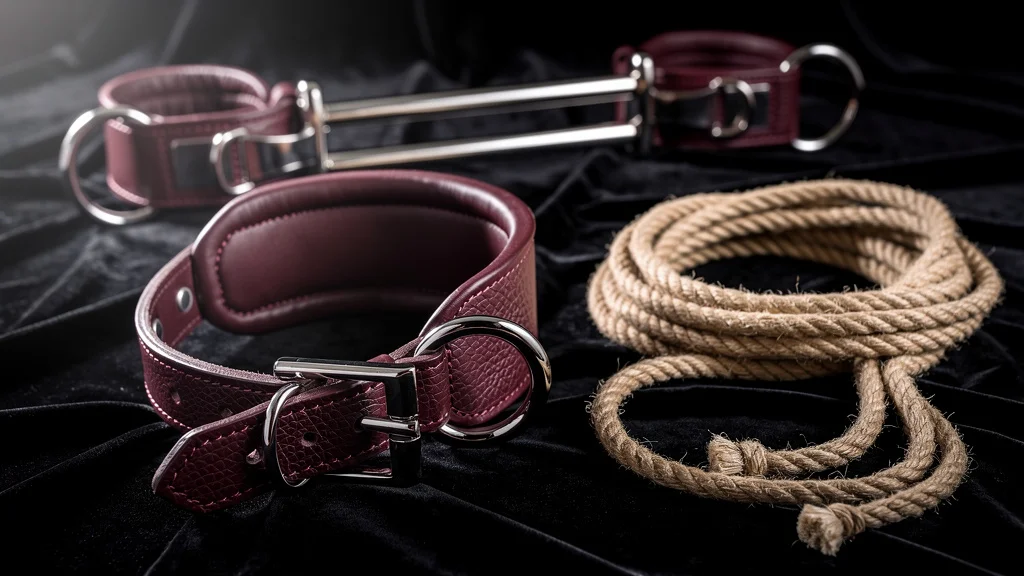
Restraints become more coherent when paired with harnesses — the bondage aesthetic extends what the harness begins. A submissive in a chest harness with wrists bound in leather cuffs has a complete visual narrative: claimed, organized, held. The harness isn’t just decoration; it’s the context for the restraints.
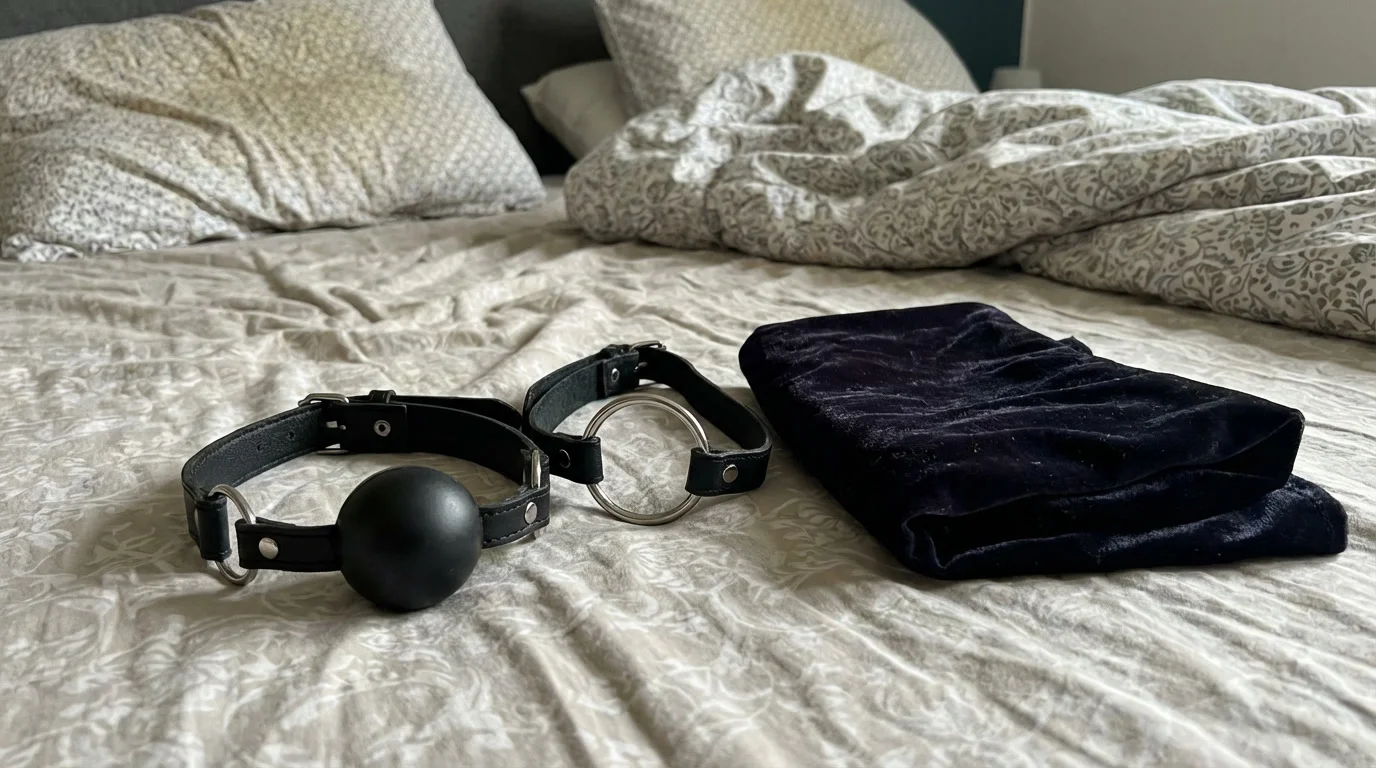
Gags pair naturally with hoods — identity removed from the face, voice removed from the throat. These layers compound each other. A submissive in a full hood who cannot speak is operating in a profound state of sensory and identity alteration that neither piece creates alone.
Impact toys interact with fetish wear in ways worth knowing: latex protects surface skin from marks while transmitting the force of impact fully. The sensation of being struck through latex is distinctive — the sting diffuses slightly, the thud transmits completely. Many submissives describe impact through latex as more intense precisely because the material muffles the surface sting and amplifies the deeper sensation.
Symbols of authority — collars, cuffs worn between scenes — layer onto fetish wear to create the most complete visual statement in the arsenal. Whatever else is worn, the collar at the throat establishes what everything else is in service of: the claim. The harness is how that claim is dressed. The boots are how that claim walks into rooms.
Explore the Arsenal:
- ← Back to The Dominant’s Arsenal
- Impact Toys — How impact changes against latex vs bare skin
- Restraints & Bondage — Harnesses as the context for physical restraint
- Sensory Play — Material plus deprivation equals compound intensity
- Gags & Silencing — Complete the transformation: hood plus silence
- Symbols of Authority — The collar that lives above everything else
Not sure which archetype you are? Take the quiz — then return to build a wardrobe that matches who you already are, not who the Halloween aisle decided you should be.