
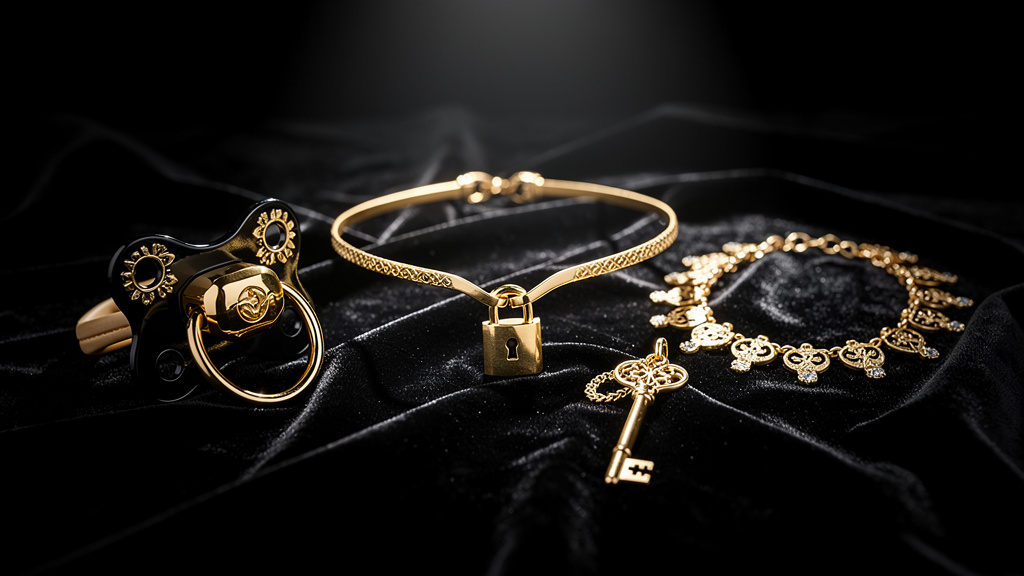
Most people shopping for DDLG accessories are doing it backwards.
They search for what looks the part — a collar with hearts, a pink pacifier, a stuffed animal that matches the aesthetic. They’re building a visual. And then they wonder why these objects feel hollow once they arrive, why the dynamic doesn’t shift the way they expected, why the items sit in a drawer after a few uses.
The problem isn’t the products. It’s the frame.
Physical objects in a DDLG dynamic aren’t props. They’re anchors. A collar worn for the first time doesn’t carry weight because it’s pretty — it carries weight because of what happened when it was put on, and by whom, and what was said. A pacifier doesn’t trigger little space because it’s designed for adults — it does so because it’s been used in moments of safety, comfort, and surrender.
The Fantasy Factory version of DDLG accessories is all aesthetics. The real version is all function.
This guide covers both. What to buy, why it works, and how to use each category of accessory to build a dynamic that has actual depth — not just a collection of things that look the part.
Why Accessories Matter in DDLG
Power exchange lives in the invisible. But invisible things need anchors.
This is true across all BDSM dynamics — a Daddy Dom creates structure, presence, and safety through hundreds of small signals. Littles find their way into headspace through rituals, language, and physical cues. Without objects that carry meaning, all of that exists only in conversation, and conversation alone is fragile.
A collar is the most obvious example, but the principle runs through every category. When a Little reaches for a specific comfort object before a scene, something shifts. When a caregiver presents a pacifier as part of a bedtime ritual, something shifts. When a Little wears a piece of jewelry that belongs to the dynamic during an ordinary Tuesday, something is held.
These aren’t arbitrary symbols. They’re tools for creating and sustaining psychological states. The best DDLG accessories are the ones that have been loaded with meaning through use — not the most expensive, not the most elaborate, but the ones that have done their job enough times to become reliable triggers.
Buy deliberately. Use intentionally. That’s the whole frame.
DDLG Collars
The collar is the foundational accessory in most DDLG dynamics. Nothing else carries the same symbolic weight.
Understanding why requires understanding what a collar actually is: it’s a physical representation of the bond. Not a costume piece, not jewelry in the conventional sense — a signal that says something specific about the relationship between the person wearing it and the person who gave it to them. Some couples treat it like a wedding ring. Others use it only in scene. The meaning is built between the two people wearing and giving it — but the object itself is the container for that meaning.
There are two main categories worth understanding.
Day collars are designed to pass in ordinary life. A delicate chain, a choker with a pendant, a piece that reads as jewelry to anyone who doesn’t know better. Day collars let Littles carry the dynamic through their daily life without explaining themselves to coworkers or family. This isn’t secrecy for its own sake — it’s about having a continuous thread that doesn’t disappear when the outside world shows up. The right day collar feels like a hand on your shoulder when no one else is around.
Scene collars are unambiguous. Leather, O-ring, locking hardware — these are not jewelry, and they’re not trying to be. A scene collar marks a shift in state. Putting it on is a ritual act. Taking it off is too. For dynamics where the collar functions as part of a collar ceremony, the scene collar is often what’s worn during the ceremony itself, with a day collar worn afterward as an everyday symbol.
Choosing between them comes down to how you live in the dynamic. Most established couples end up with both. Start with whichever one serves the dynamic you’re actually building — the subtle thread through daily life, or the clear marker during dedicated time together.

A delicate chain collar that reads as elegant jewelry in ordinary life while carrying real meaning within the dynamic. Clean, understated, wearable anywhere.
Affiliate link - price may vary. We may earn a commission at no extra cost to you.
Genuine leather construction with O-ring hardware. Built for ritual and presence — this is a collar that knows what it is.
Affiliate link - price may vary. We may earn a commission at no extra cost to you.
Craftsman-grade collar with locking hardware. For dynamics where the collar ceremony carries serious weight — this is the piece built for that moment.
Affiliate link - price may vary. We may earn a commission at no extra cost to you.
Pacifiers and Comfort Items
An adult pacifier is not a novelty item. Used correctly inside a dynamic, it’s one of the most effective little space triggers available.
The mechanism is partly sensory — the sucking reflex is associated with comfort and safety at a neurological level, well below conscious thought. But more than that, a pacifier used consistently within the dynamic becomes a conditioned anchor. The Little who has been offered a pacifier by their caregiver during moments of vulnerability, during aftercare, during bedtime rituals — for that person, the pacifier carries a whole emotional context. Holding it, even during an ordinary evening, can initiate a shift in headspace that would otherwise require much more deliberate setup.
Adult pacifiers differ from children’s versions in size and sometimes in material, but functionally they serve the same purpose. Some couples choose pacifiers in specific colors or with specific designs that belong to the dynamic. Others use a single pacifier that becomes strongly associated with particular rituals. What matters is consistency — using the same object in the same contexts until it does its job without effort.
Comfort items extend the same principle. A specific sippy cup used only during little space. A soft blanket kept at the caregiver’s space. A plush animal that belongs to a bedtime ritual. The item itself is secondary — the context in which it appears is what gives it weight.
Designed for adult sizing, with a soft shield and comfortable nipple. A practical comfort anchor for little space rituals and caregiving scenes.
Affiliate link - price may vary. We may earn a commission at no extra cost to you.
Stuffed Animals and Plushies
Most DDLG guides treat stuffed animals as background scenery. A soft detail. Something to photograph.
That’s the wrong read.
A stuffed animal that has been present during vulnerable moments — scenes, aftercare, nights when little space opened up unexpectedly — is not decorative. It accumulates context. Some Littles name their stuffed animals and treat them as a consistent character within the dynamic. Others simply keep a specific plush nearby during little space because its presence has come to signal safety.
Caregivers can work with this deliberately. Introducing a stuffed animal as a gift at a significant moment in the dynamic gives it a specific origin story. Including the plush in bedtime rituals, or returning it as a comfort object after a particularly intense scene, builds its significance over time. The most important stuffed animal in a dynamic isn’t the most expensive or the largest — it’s the one with the most context attached to it.
From a practical standpoint, look for plushies that are genuinely soft, well-constructed enough to last, and appropriately sized for actual use rather than display. A plush that feels good to hold matters. Aesthetics secondary; quality and feel first.
DDLG Toys and Activities
There’s a distinction worth making clearly: this section is about Little activities, not adult toys.
Coloring books designed for adults have become a mainstream category, and several of them work well in a DDLG context — intricate enough to hold attention, with the kind of focused repetitive activity that supports a specific headspace. This is genuinely useful for little space. The act of coloring, particularly with good materials, produces a quality of attention that is both absorbing and calm. Caregivers who set up a coloring activity for their Little are providing structure without restriction — a recognizable feature of good caregiving.
Building sets, puzzles, and sticker books serve similar functions. The key is activities that are engaging at a lower-intensity cognitive level — activities that allow the mind to settle without demanding too much of it. This is what makes them useful for little space induction and maintenance.
The DDLG coloring books category in particular has grown significantly — there are now options ranging from simple and large-scale to detailed and intricate, which means caregivers can match the activity to where their Little is on a given day. A Little who is already in a deep little space state needs different input than one who is just settling in.
Board games designed for children but enjoyable for adults — Candy Land, Chutes and Ladders, cooperative games with simple mechanics — can also work well as a shared activity during little space scenes. The caregiver’s role in choosing and running the activity matters as much as the activity itself.
DDLG Jewelry and Symbols
The collar gets all the attention, but it’s not the only jewelry that can carry meaning in a DDLG dynamic.
Locking jewelry is the most BDSM-specific category. A bracelet or anklet secured with a small lock, with the key kept by the caregiver, does the same psychological work as a collar — it marks something about the relationship without requiring explanation. This category has grown considerably, and well-made pieces are available across price points. The best locking jewelry reads as decorative to outsiders while being clearly significant within the dynamic.
Matching pieces — a bracelet set where the Little wears one version and the caregiver keeps the other, or where both wear a version of the same design — do different work. They create a visible thread between two people that only they know the full meaning of. This is particularly meaningful for long-distance dynamics or situations where other physical forms of connection are limited.
Engraved pieces add another layer of specificity. A pendant with a date, a word from the dynamic’s private vocabulary, or a simple symbol that belongs to the relationship — these are the pieces that become heirlooms. They’re not the first thing to buy, but for an established dynamic, an engraved piece is often the accessory that carries the most weight per dollar.
Charm bracelets work well for Littles who want to build something over time. A caregiver who adds a charm at significant milestones creates a physical record of the dynamic’s growth — something that can be worn openly without explanation and understood fully by only one other person.
Elegant locking jewelry that reads as refined accessories in public while carrying clear meaning within the dynamic. Key kept by the caregiver.
Affiliate link - price may vary. We may earn a commission at no extra cost to you.
Gift Ideas for Your Little (or Your Caregiver)
Gift-giving in a DDLG dynamic is a caregiving act. Done well, it reinforces roles, builds the relationship’s physical environment, and demonstrates that the caregiver pays attention. Done poorly — buying whatever was easy — it misses the point entirely.
The question isn’t just what to buy. It’s what signal the gift sends. A gift that is clearly chosen for this specific Little, for this specific dynamic, lands differently than a generic piece from a gift guide.
With that frame in place, here’s how to think about it by budget.
Under $25
The most useful gifts at this price point are activity items and small comfort anchors. A quality adult coloring book plus a set of colored pencils is a complete little space toolkit that costs very little. A custom adult pacifier ordered in the Little’s specific colors or with a personalized design adds meaning far beyond the price. Hair accessories — ribbons, clips, bows — are everyday wearable pieces that many Littles genuinely use. A sticker set chosen around the Little’s specific interests (animals, nature, characters they love) is a small gift that shows attention.
$25–$75
This is the range where the most important category purchases live. A day collar — properly chosen, from a quality maker — sits here. A well-made stuffed animal with good materials. A matching pajama set in soft fabric that can become a little space ritual anchor. A sippy cup or bottle set that belongs to bedtime or care rituals. A small piece of locking jewelry.
The key at this range is choosing one deliberate item rather than several generic ones. One thing that says “I chose this for you” beats three things from a cart.
$75 and above
A premium scene collar or locking collar with ceremony weight. A jewelry set — locking bracelet plus pendant or charm bracelet starter set. A comfort item bundle assembled by the caregiver — plush, blanket, pacifier, a small care kit — given together as a coherent gift. A custom or engraved piece designed specifically for the dynamic.
At this range, the gift becomes a statement about the relationship. The question to ask before purchasing: does this piece belong in our dynamic specifically, or is it just expensive?
A curated set of DDLG accessories well-suited for gifting — practical, wearable pieces that work as both everyday items and meaningful dynamic anchors.
Affiliate link - price may vary. We may earn a commission at no extra cost to you.
Where to Shop
Not all DDLG accessories are sold in the same places, and quality varies enormously. Generic costume sites and mainstream marketplaces often carry cheap, poorly made versions of pieces that exist in much better quality elsewhere.
For a full breakdown of vetted shops across all categories — collars, jewelry, comfort items, clothing — see the recommended shops page.
The short version: shops that specialize in BDSM and power exchange dynamics understand how these items are actually used and tend to build them accordingly. A collar from a shop that knows what a collar ceremony is will be better constructed than one from a shop that considers it a costume piece.
This matters most for collars and locking jewelry, where construction quality directly affects daily wearability and longevity.
Common Questions
What’s the best first DDLG accessory?
A day collar, if the dynamic involves a caregiver who wants to give one. It’s the piece with the most functional range — wearable daily, carries the dynamic’s meaning, doesn’t require any explanation. If the dynamic is solo-focused or the Little is building their own little space toolkit, a comfort object (stuffed animal, pacifier) that gets used consistently in little space practice is the most immediately useful first purchase.
Can I wear a day collar to work?
Yes, that’s the point. A well-chosen day collar is indistinguishable from regular jewelry to anyone who doesn’t already know what it is. A delicate chain, a pendant choker, a simple necklace with a small lock detail — none of these require explanation. The meaning belongs to the people in the dynamic.
How do I explain DDLG accessories to vanilla friends or family?
You don’t, unless you want to. A day collar is jewelry. A pacifier, if seen, is a comfort item (anxiety relief, sensory tool). Stuffed animals need no explanation for most adults. The DDLG clothing guide covers the broader question of maintaining a DDLG-influenced wardrobe in a mixed social environment — the same principles apply to accessories.
Should the caregiver choose accessories or the Little?
Both, depending on the category. Collars are traditionally given by the caregiver — that act of giving is part of the meaning. Comfort objects like stuffed animals and pacifiers often work best when the Little chooses them, since personal resonance matters for those items. Jewelry and clothing accessories can go either way, and the best dynamics usually involve conversations where the caregiver pays close attention to what the Little gravitates toward and then chooses deliberately within that space.
Do accessories matter if the dynamic is primarily online or long-distance?
More than in-person dynamics, arguably. Physical objects bridge geographic distance in ways that video calls and messages can’t. A Little who wears a day collar sent by their caregiver, or who keeps a stuffed animal that carries meaning, has a physical thread to the dynamic regardless of distance. This is one of the best use cases for locking jewelry — both people can wear matching pieces and the connection is physical regardless of where they are.
Key Takeaways
DDLG accessories are tools, not props. The difference between a collar that means something and one that sits in a drawer is not price or quality — it’s context. Objects accumulate meaning through use, ritual, and the attention with which they were given and received.
Start with the category that serves your dynamic most directly. For most people, that’s a collar. For Littles building a little space practice, it’s comfort items. For established dynamics looking to deepen the physical environment of the relationship, jewelry and activity items extend what’s already there.
Buy from shops that understand how these items are used. Use objects consistently enough that they earn their meaning. And approach gifting as a caregiving act — which means choosing deliberately rather than conveniently.
The Fantasy Factory version of DDLG accessories is a collection of things that look the part. The real version is a small set of objects that carry the weight of a relationship.
That’s a different shopping list.
More on building your dynamic: DDLG rules and structure | Little space guide | DDLG clothing guide | Complete DDLG guide