
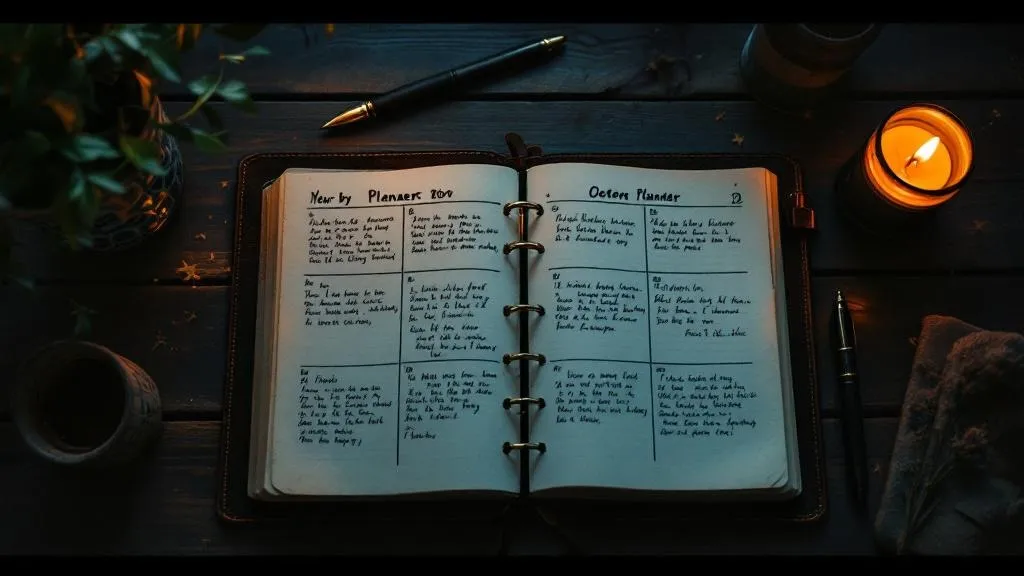
You’ve said it. She’s said it. The weekend came and went.
“We’ll be spontaneous this weekend.”
Netflix. Exhaustion. Dishes. A child with a nightmare at 2am. Another week of work starting Monday before either of you had a chance to breathe, let alone connect. The spontaneous scene that was going to happen — didn’t.
It never does.
And here’s what nobody tells you when you’re building a D/s dynamic in a real life with real pressures: spontaneity is not a relationship strategy. It’s a fantasy. The Fantasy Factory sold you on stolen moments and the electricity of the unplanned. What they didn’t show you is what happens after year three, after the second kid, after the promotion that comes with three extra meetings a week.
The couples who maintain a genuine dynamic — through jobs and kids and aging parents and the thousand small obligations of a real life — are not the spontaneous ones. They are the deliberate ones.
Planning is not the enemy of passion. Planning is how you protect it.
Why Scheduled Is Better Than Spontaneous
Somewhere along the way, you absorbed the idea that scheduling intimacy means it’s dead. That you’re putting kink on a calendar the way you schedule oil changes.
That’s backwards.
When you schedule a scene, you create a horizon. She knows it’s coming. You know it’s coming. Every day between now and that evening is saturated with meaning — the glance across the dinner table, the text message mid-afternoon, the moment you tell her to be ready at 8. None of that happens with spontaneity because there’s no approaching moment to orbit around.
Anticipation is foreplay. It is possibly the most underrated tool in your kit. A well-placed reminder three days out does more psychological work than ten minutes of rushed warm-up on a night you didn’t plan for.
Scheduling also signals something deeper: that this matters enough to protect. When you put it on the calendar, you’re telling her — and yourself — that this dynamic is not something you’ll get to whenever life allows. It’s something you make room for, deliberately, the way you make room for anything that matters.
The alternative is entropy. Without intention, the dynamic doesn’t stay at the same level — it degrades. Not because either of you stopped wanting it. Because life fills every available space if you don’t hold some of that space intentionally.
The couples who let spontaneity be their strategy eventually stop talking about scenes at all. Not out of disinterest. Out of resignation.
Don’t resign. Schedule.
The Weekly Rhythm
The first question people ask when they want to build structure is: how often?
The honest answer: not as often as you think, and more consistently than you’re currently managing.
You don’t need a full scene every week. You need rhythm. And rhythm does not require peak performance every cycle — it requires showing up on a predictable schedule even when you don’t feel like a Dom, even when she’s tired, even when Tuesday was brutal.
Here’s a framework that works for most couples with children and demanding schedules:
Light week: Dominance expressed in daily life. Morning check-ins, specific tasks, a collar worn around the house after the kids are down. No formal scene, but the dynamic is maintained. This is your maintenance week.
Medium week: A contained scene of 30-60 minutes. Something with clear structure — a ritual, a specific protocol, a physical element that’s been negotiated. This can happen on a weeknight if the timing is protected.
Full week: Two hours or more. Room set up. Real aftercare planned. This is your production. It needs a weekend window or a night you’ve both agreed to treat as sacred.
Rotate through those loosely. If you have two back-to-back brutal weeks, you stay in light mode — but you stay in it. You don’t disappear. You don’t put the dynamic “on hold.” You just turn the volume down, not off.
The rhythm is the thing. Break it, and it takes three times as long to rebuild than it would have taken to maintain.
”Scene Night” as Protocol
Call it whatever you want — Date Night, Thursday, your name for it — but make it a thing that exists. A recurring anchor point on the calendar that both of you know is protected.
The danger is treating it like other plans, which means it becomes the thing that gets cut when something else comes up. It can’t be that. It has to be the thing that other things get cut for.
Some practical ways to protect it:
Block it in both calendars as a standing event. No exceptions for work calls. If childcare arrangements need to happen, those get organized around it, not the reverse. When someone wants to schedule something on that evening, the answer is no before you even look at why.
Transition rituals matter enormously here. You go from parent-mode and worker-mode directly into a scene and it doesn’t land. The headspace isn’t there. So build the transition deliberately.
This might look like: kids are settled, the door to your bedroom is closed, you each take twenty minutes to get ready separately. She knows what that means. You change clothes deliberately — whatever signals the shift for you. Maybe it’s as simple as washing your hands and taking three slow breaths. The ritual doesn’t matter. The intention behind it does.
Getting ready together can be foreplay. She’s preparing herself for you. You’re watching her understand the evening ahead. That shared awareness — both of you moving toward the same moment — is already the beginning of the scene.
When you enter the room with intent, you’re not starting the scene. You’re completing a transition that began an hour ago.
Micro-Moments of Dominance
This is what sustains a dynamic between scenes.
You do not need a two-hour window to be her Dom. You need two minutes and intention.
Micro-moments are the daily current that keeps the dynamic alive. A specific touch on the back of her neck as you pass her in the kitchen. A text at 2pm: “I’ve been thinking about you.” A single command given in a low voice before you leave for work. Eye contact held two seconds longer than casual.
These are not substitutes for scenes. They’re the connective tissue between them.
Without micro-moments, the dynamic exists only on scene nights — and starts to feel like a costume you put on and take off. With them, the dynamic is the relationship, and scene nights are just the evenings when that current is turned all the way up.
Some specifics that work:
A morning ritual that takes under three minutes. Her making your coffee. You reviewing her tasks for the day. A physical check-in — a touch that means something specific between you.
A mid-day text protocol. You reach out. She acknowledges. Brief, but loaded with meaning because you’ve agreed on what it means.
An evening debrief. Before sleep, five minutes where she tells you one moment from her day. You listen with full attention. This is dominance expressed as presence — not as command, but as the gravity that holds space for her.
None of this requires time you don’t have. It requires attention directed with intention.
The 15-Minute Quickscene
Not every encounter needs to be a production.
There is a version of a scene that takes fifteen minutes, uses almost nothing, and lands with full intensity. It’s not a lesser scene. It’s a different kind — compact, concentrated, precise.
What works in 15 minutes: restraint and sensation. Blindfolds. Specific commands. Impact with a single implement. Breath focus. A protocol executed in compressed form.
What doesn’t work: elaborate setups, roleplay with character development, multiple implement switches, extended aftercare intensive play. Save those for full scene nights.
The 15-minute quickscene lives or dies on setup speed and transition clarity. You both know what’s happening before you begin. Negotiation for these happens outside the moment — during the week, in a check-in, in a text. By the time you’re standing in the bedroom at 9:30pm with 45 minutes before you both need to be asleep, there’s no time to discuss. You need an existing framework you can step into.
Pre-agreed quickscene protocols solve this. “We’re doing Protocol C tonight” means you both already know the shape of the next fifteen minutes. No negotiation required. Just execution.
Build two or three of these frameworks. Test them. Refine them. Then reach for them on the nights when a full scene isn’t available but disappearing entirely isn’t acceptable either.
Calendar Integration Without Evidence
You have kids. Maybe houseguests. Maybe family that uses your devices. You need to plan without leaving trails.
A few practical approaches:
Coded entries. “J + L project” on a shared calendar. “Training session.” Any phrase that means something to both of you and nothing to anyone else. You don’t need to be elaborate — just consistent.
Private calendar. Both of you maintain a separate personal calendar, shared only with each other, that holds the actual content. On the shared family calendar, the time block exists. The details live elsewhere.
App options. Paired apps with end-to-end encryption work well here. Standard Notes, Signal, or a private shared document in an app that doesn’t auto-populate into family shares. Nothing kink-specific that would cause problems if someone else opened the phone.
Text protocol. Some couples handle all scene planning over a specific thread in a messaging app that requires a passcode. The conversation history stays there and doesn’t surface in notifications or previews.
The goal isn’t elaborate secrecy. It’s appropriate privacy. You’re adults in a consensual relationship. You don’t owe anyone access to your dynamic. Building systems that protect your planning space is not paranoia — it’s maturity.
When Plans Fall Through
It will happen. A child gets sick. A work emergency appears at 7pm. One of you hits a wall of exhaustion that you couldn’t have predicted that morning.
How you handle cancellations matters as much as how you protect the time in the first place.
The worst thing you can do is let resentment accumulate silently. One partner is disappointed. The other feels guilty. Neither says anything. The next scene night arrives already weighed down by the last one that didn’t happen.
The rain check protocol solves this: when a scene has to be cancelled, you name the replacement before the night ends. Not “sometime soon.” A specific date. Within the next seven days if possible. The replacement is treated with the same protected status as the original.
This does two things. It tells your partner that the cancellation wasn’t an abandonment — the dynamic is still real, still prioritized, and a new moment is already coming. And it keeps you from letting one missed week become a month of drift.
Grace over guilt is the operating principle here. Life with children and careers is chaotic. You’re not failing your dynamic when a scene gets cancelled. You’re failing it if you don’t reschedule and don’t acknowledge what was lost.
Hold a brief check-in when plans fall through. “I know tonight didn’t happen. I’ve got Thursday blocked. We’re still on.” Two sentences. It costs nothing and it means everything.
Frequently Asked Questions
Does scheduling scenes really work, or does it just feel forced?
Forced is a frame problem, not a scheduling problem. Scheduled scenes feel forced when you haven’t done the work of building anticipation between them — when the calendar is the only thing holding the dynamic together instead of being one layer of it. When you’ve maintained daily micro-moments and ritual contact through the week, walking into a scheduled scene doesn’t feel forced. It feels like arriving somewhere you’ve been moving toward all week.
How do we negotiate quickscene protocols without killing the spontaneity?
You negotiate the framework, not the specifics. “Protocol C” might mean: blindfold, two implements, fifteen minutes, no talking allowed except safe words. The framework is the same. How you execute inside it varies every time. The structure creates safety; what you do inside it stays alive.
What if one partner wants more scenes than the other can manage?
This is a mismatch worth having an explicit conversation about — outside of any scene context. The question to answer together: what is the minimum viable rhythm that keeps the dynamic healthy for both of you? Start there, and build up only when the lower-threshold partner is genuinely ready. Pushing past what someone can sustainably give degrades the dynamic faster than scaling back does.
How do we get back into rhythm after a long break — illness, travel, a brutal month?
Start light. Don’t try to do a full scene after three weeks off. A medium protocol, a micro-moment with structure, a deliberately planned check-in. Ease back in. The dynamic doesn’t evaporate during hard months — it waits. You bring it back by showing up again, not by compensating for the time you were away.
What’s the minimum time investment to keep a D/s dynamic genuinely alive?
Realistically: one contained scene per month as an absolute floor, plus daily micro-moments that take under five minutes each. Below that, the dynamic starts to exist only in memory rather than in lived relationship. The daily micro-moments are actually more important than scene frequency — they’re what keeps the current running between the peaks.
What Comes Next
If keeping a dynamic alive with children in the house is the broader challenge you’re working through, that piece covers the full picture — soundproofing, timing, the mental load of compartmentalization.
For the quiet nights when a full scene isn’t an option, low-noise activities gives you a concrete toolkit for when the house isn’t yours alone.
And if you want to understand how to build the kind of anticipation that makes scheduled scenes land with full weight, The Negotiated Surprise breaks down the mechanics of engineering that tension deliberately.
The dynamic you want is possible inside the life you actually have. Not a different life — this one, structured differently.
That starts with a decision: this matters enough to plan for.
Find out what kind of Dom you actually are — and what your dynamic needs most.