People have died doing this.
Not in dramatic, obvious ways. Not because they were reckless or stupid. They died because they were alone, something went wrong, and there was nobody there to fix it. They had planned well — until the one thing they hadn’t planned for happened. An ice lock that melted slower than expected. A position that cut off circulation faster than they thought. A panic response that made the situation worse before they could recover.
I’m not telling you this to scare you off. I’m telling you this because I’m not going to pretend self-bondage is like other solo kink activities. It isn’t. It is categorically the most dangerous thing you can do in kink by yourself, and the people who treat it like a casual Tuesday activity are the ones who end up in emergency rooms — or don’t.
This article exists because people practice self-bondage. They have for as long as there has been rope and curiosity. They will continue to do so regardless of what any guide says. So the question isn’t whether you should or shouldn’t. The question is: if you’re going to do it, are you doing it in a way that keeps you alive?
That’s what we’re going to cover. No judgment. No romanticizing the risks. Just the information you need to make it survivable.
The Real Risks (Read This Before Everything Else)
The Fantasy Factory — the media complex that has taught most people what kink “looks like” — has a specific image of self-bondage: someone tied up, looking beautiful, completely in control of the situation. They wriggle, they escape, everything is fine.
That image is missing the part where it goes wrong.
Here are the actual ways self-bondage kills or seriously injures people:
Positional asphyxia. This is the silent killer of restraint-related deaths — and it’s not just about things around the neck. When your body is held in a position that restricts the mechanics of breathing, you can suffocate without anything touching your airway. A chest harness that’s too tight. A hogtie that forces your ribcage into a compressed position. Being face-down and unable to turn over. You don’t need a ligature around your neck to asphyxiate. You need a position that won’t let your diaphragm work. This happens faster than you think — unconsciousness can occur within minutes, and from there the outcome depends on whether someone finds you.
Nerve damage. Compression of peripheral nerves — particularly in the arms — can cause lasting damage in as little as 20-30 minutes. The radial nerve (runs along the outside of the upper arm) is especially vulnerable. “Saturday night palsy” — the colloquial term for wrist drop caused by compressed radial nerve — is well-documented in medical literature. When you’re in restraints alone, you can’t respond to early warning signals the way you would with a partner. You may not notice numbness starting until it’s been going on too long.
Circulation loss leading to tissue damage. Anything cutting into skin — rope, cuffs, zip ties — can cut off circulation. The risk compounds over time. What’s fine at ten minutes becomes a problem at forty. What’s manageable with a partner (who can check on you) becomes dangerous alone (where you can’t easily access or check the area).
Inability to escape under stress. Here is the thing about escape mechanisms that nobody tells you: they work perfectly in practice, and sometimes fail in exactly the moment you need them. The ice lock melts unevenly. The key you placed at the end of the rope has moved just out of reach. Your hands are numb enough that fine motor control is gone. You’re calm in testing, and you’re panicked in reality — and panic makes everything worse. Suddenly a simple release takes three times as long, and you’ve been in that position for longer than you planned.
Cardiac events. Prolonged stress, cold exposure, and physical restriction can trigger cardiac arrhythmias in people who have no known heart conditions. This is rare — but rare still kills people.
Falls. Standing bondage, suspension, and anything that affects your balance combined with being alone is a fall risk. If you go down, you may not be able to get back up, and you will be in restraints while you try.
There are no statistics on self-bondage deaths that are cleanly categorized — most deaths get filed under “accidental asphyxiation” or simply “unknown.” What we do have are case reports, emergency room data on restraint-related injuries, and firsthand accounts from communities that have been doing this long enough to have buried people.
The risk is real. Now let’s talk about how to minimize it.
The Non-Negotiable Rules
These are not suggestions. These are the conditions under which self-bondage becomes survivable. If you can’t follow all of them, you don’t do the scene.
Never anything around the neck. Full stop. No exceptions. No “just a loose loop.” No “it’s only for a moment.” The neck is off-limits in self-bondage. Period. Ligature around the neck during restraint — even when the person intends it to be loose — is one of the most reliable ways to die in this context. I don’t care what you’ve seen, what someone told you was safe, or what you’ve done before. The neck does not get restrained when you’re alone.
Always have a working, tested timed-release method. Not a method you think will work. A method you have tested. Multiple times. Under conditions that resemble actual use — meaning with your hands in the position they’ll be in, in the same lighting, at the same level of fine motor challenge. If the release method doesn’t work in your kitchen at full capability, it will not work when you’re stressed, in dim light, with numb fingers.
Never practice under any kind of impairment. Alcohol. Cannabis. Prescription sedatives. Sleep deprivation beyond your normal threshold. Anything that alters your reaction time, your judgment, or your ability to execute your escape plan. This is non-negotiable because the gap between “mildly impaired” and “completely unable to respond to an emergency” is much smaller than most people believe, and you need full capability available to you.
Always have a safety contact. This means a real person who knows: what you’re doing, where you are, and at what time they should call you. If you don’t answer, they call for help. This is not optional. It is the last line of defense between “emergency” and “tragedy.” The person doesn’t need to know every detail — they just need to know to call you at X time and to send help if you don’t respond.
Never use locks without a guaranteed backup key. Key locks require fine motor control to operate. Fine motor control is often compromised by the time you actually need to escape. If you insist on locks, there must be a backup key somewhere you can reach it even with significantly impaired hand function — not just “somewhere in the room.”
Escape Methods That Actually Work
Your escape method is not an afterthought. It is the most important piece of equipment in the entire scene. Design it before you design anything else.
Ice locks (timed release). A key or release mechanism frozen in ice. When the ice melts, you can access it. The appeal is that they’re reliable and require no action from you to initiate. The critical issue is testing: ice melts at different rates depending on the container, the room temperature, and how much water you used. You must test your specific setup, in your specific environment, multiple times before relying on it. Give yourself a significant buffer — if you want a 30-minute scene, your ice release should be tested to work at 20 minutes. Errors in ice timing run long, not short.
Magnetic releases. Strong magnets holding a closure shut. When the magnet is close enough to the catch, it releases. The challenge is placement: the magnet needs to be somewhere you can get to it, and the geometry needs to work with hands that may have reduced range of motion. Test extensively.
Velcro cuffs and snap-releases. These are the lowest-risk restraint options for self-bondage because they don’t require fine motor control to escape. A hard enough pull releases them. If you’re newer to self-bondage, start here. Yes, they’re easier to escape — that’s the point.
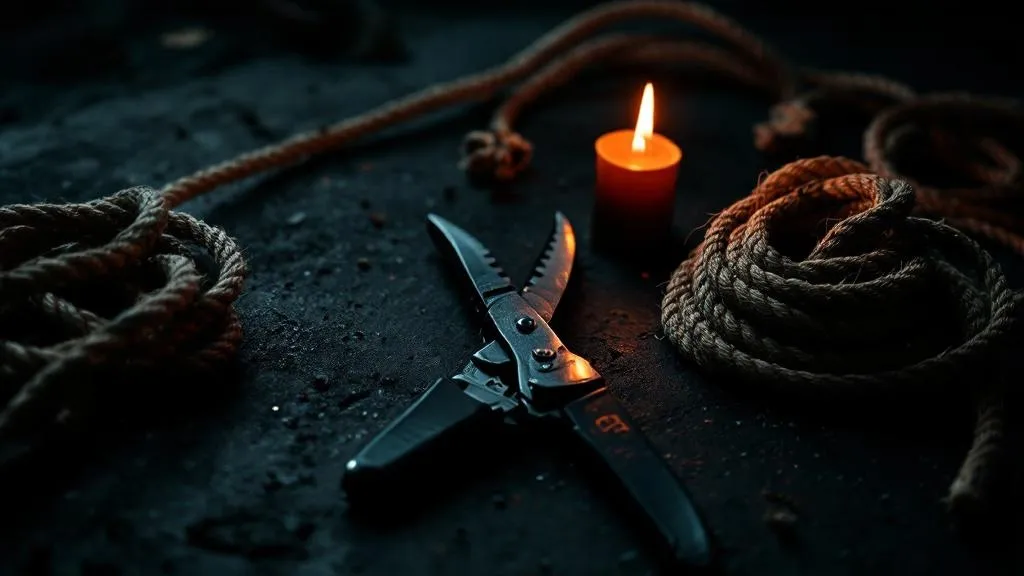
Scissors/safety shears, always accessible. Position a pair of safety shears — the kind with a blunt tip that won’t stab you — within reach of your hands, secured in a way that they won’t fall out of reach if you move. This is your backup to every other escape method. Rope can always be cut. Know where they are before you’re in restraints.
Phone within reach. Your phone should be accessible. Screen unlocking can be managed with biometrics even with limited hand function. If something goes wrong, you may need to call your safety contact or emergency services. A phone across the room is functionally not a phone.
The “can I escape right now” rule. Before you add any more restriction, ask: if I needed to get out of this right now, in the next 60 seconds, could I do it? The answer must always be yes.
Safe Positions vs. Dangerous Positions
Not all restraint positions carry the same risk when you’re alone.
Lower risk positions:
Seated on the floor with your back against a wall. You can’t fall, you’re not compressing your chest, and getting out of a seated position is achievable even with limited mobility. Lying on your back on a flat surface. Your airway is clear, you can breathe, and you have some ability to move.
Higher risk positions:
Face-down (prone). Lying face-down is significantly more dangerous than lying face-up. In this position, your body weight works against your diaphragm, and if you’re restrained in a way that prevents turning over, positional asphyxia becomes a real risk. If you must use a prone position, ensure you can turn over independently. Standing. Falls. Simple as that. If you’re restrained and you fall, you cannot catch yourself and you cannot easily get up. Standing restraints are high-risk solo. Bent over furniture (over a chair back, sawhorse, etc.). If you shift position or fall, you may end up in a much more dangerous posture than you started in.
Never, under any circumstances, solo suspension. This means any position where your weight is partially or fully supported by the restraints. The failure modes are too severe, too fast, and too unrecoverable. Suspension bondage belongs in the category of partnered-only, experienced-only, rigger-trained activities. There is no version of suspension that is appropriate for solo practice.
Equipment for Solo Practice
The right gear for self-bondage is not the same as the right gear for partnered bondage. You need restraints that give you the experience you’re looking for while remaining escapable under duress.
Velcro restraints. Underrated. Not as aesthetically interesting as rope or leather, but they release with force and require no fine motor control. Good starting point, especially if you’re building confidence in your setup.
Thumb cuffs and quick-release handcuffs. Quick-release cuffs — the kind designed with an emergency release mechanism built in — are significantly better for self-bondage than standard lock-and-key cuffs. The release should be something you can operate with one hand, with limited grip strength, in a stressed state.
Snap hooks (carabiners with spring gates). These can be pushed open with pressure even when your hands are restricted. Test the specific snap hooks you plan to use.
Rope with practical length and pre-tied loops. If using rope, softer options (cotton, hemp after conditioning) are kinder to skin during extended wear. Pre-tie any loops or structures before the scene starts. The knots you tie under stress are not the knots you tie when calm. Simplicity matters more in self-bondage than in partnered rope work.
What to avoid: Zip ties. Chains with small locks. Any fastener that requires two fully functional hands to open. Anything with no quick-release option whatsoever. Saran wrap and similar materials (circulation and heat risks compound quickly).
For a fuller breakdown of restraint gear, see our guide to restraints and bondage.
The Pre-Scene Checklist
Run this every single time. No exceptions for “quick” sessions, no exceptions when you’re feeling confident.
Physical state:
- Hydrated (dehydration worsens all physical stress)
- Not hungry — light meal at least an hour before
- No alcohol consumed in the last 12 hours
- No cannabis, sedatives, or anything else affecting judgment or reaction time
- Not severely sleep-deprived
- No existing injuries that could be worsened by restriction or reduced circulation
Environment:
- Room temperature is comfortable — not cold enough to accelerate hypothermia, not hot enough to cause heat stress
- Floor is clear of obstacles between your position and the door
- Phone is charged, accessible, and unlocked (or biometric)
Equipment:
- Every escape mechanism has been tested today, in the current conditions
- Safety shears are positioned and accessible
- Backup key (if using locks) is confirmed in its location
- No restraints are going near the neck
Safety contact:
- One person has been told: what you’re doing, your location, and the exact time they should call you
- You have confirmed they understood and will actually do it
- They have instructions to call emergency services if you don’t answer
Scene parameters:
- You have set a specific time limit for the scene
- Your timed release is set for shorter than that time limit
- You have told your safety contact the outer time limit, plus buffer
If you can’t check all of these, the scene doesn’t happen. Not today. Not until the unchecked box is resolved.
If Something Goes Wrong
Stay calm. I know that sounds impossible in a panic, but it’s the most tactically important thing you can do, because panic actively reduces your ability to execute your escape.
Control your breathing first. Slow, deliberate breaths. Hyperventilating makes everything worse — it accelerates oxygen use and reduces your cognitive function. Take ten seconds and breathe before you do anything else.
Identify your primary escape method and try it once, slowly. Not frantically — slowly. Rushing a release mechanism is how you fumble it. If it doesn’t work on the first controlled attempt, move to the backup.
If your primary and backup both fail, get to your phone. Call your safety contact first. They know where you are. If you cannot reach them in under 60 seconds, call emergency services. There is no scenario where “I don’t want to explain this to paramedics” is worth your life. Emergency responders have seen everything. They will not judge you. They will help you.
If you cannot reach your phone, make noise. If you’re in a location where someone might hear, make as much noise as possible.
If you cannot make noise and cannot reach your phone, focus on slow, steady breathing and wait for your safety contact to act. This is why the safety contact is not optional — they are your last resort, and they should be a real person who will actually follow through.
The medical reality: positional asphyxia and nerve compression both worsen with time. Staying calm and breathing slowly actually slows the deterioration. Panic accelerates it. Your best tool in an emergency is a clear head.
Why Harm Reduction Matters Here
Some people reading this article will have been hoping for a version of me that says “you shouldn’t do this at all.” I understand the impulse behind that position.
But I have been doing this long enough to know that telling someone “don’t do the thing” when they’re already doing the thing — or planning to do the thing — is not harm reduction. It is abandonment. It gives people the impression that there’s a clean binary between “perfect safety” and “self-bondage,” and leaves them with no information for the reality they’re already operating in.
The truth is that people in The Underground practice self-bondage. They have done so for decades. The ones who do it well, the ones who do it for years without incident, are not the ones who never took risks — they’re the ones who took the right risks with the right preparation and the right equipment.
What I’m asking you to do is not stop being curious. I’m asking you to treat this particular activity with the weight it deserves — which is significantly more weight than any other solo kink practice — and to build the infrastructure around your practice that makes survival the expected outcome rather than a lucky accident.
If you’re moving toward partnered rope work, the complete shibari guide covers the full technique library alongside the safety and communication principles that make rope work between two people sustainable over time. See also: Safety Tips for Shibari Beginners — the safety principles that apply in partnered rope work are directly relevant here.
The Bottom Line
Every scene you do alone should be designed around one principle: your life is not worth a scene.
Not the intensity of the experience. Not the aesthetics of the setup. Not the inconvenience of having to call someone and tell them what you’re doing. Not the awkwardness of explaining safety shears to a paramedic.
Your life.
The real work in self-bondage safety isn’t the gear — it’s the mindset shift that gets you to actually take the checklist seriously every single time, to actually set up the safety contact before the scene instead of after, to actually test the escape mechanisms instead of assuming. That shift, from “this is probably fine” to “I’m treating this like the serious risk it is,” is the difference between a long practice and a preventable tragedy.
If you’re still building your understanding of what safe, ethical practice actually looks like — not just in self-bondage but across all the kink activities you’re curious about — take the quiz. It’s the fastest way to understand where you are and what you need to know next.
Stay smart. Stay safe.
— Sir Linus